The Multi-Million Dollar Monolith Trap
Enterprise software sales pitches often disguise inflexibility as "best practice." In reality, forcing a high-growth distributor or innovative manufacturer into rigid, predetermined ERP schemas suffocates competitive differentiation.
Companies spend $2M+ on SAP or NetSuite deployments, wait 18 months for systems integration consultants, only to discover their business model changed during the implementation window. Customizing the monolith requires another six-figure change order.
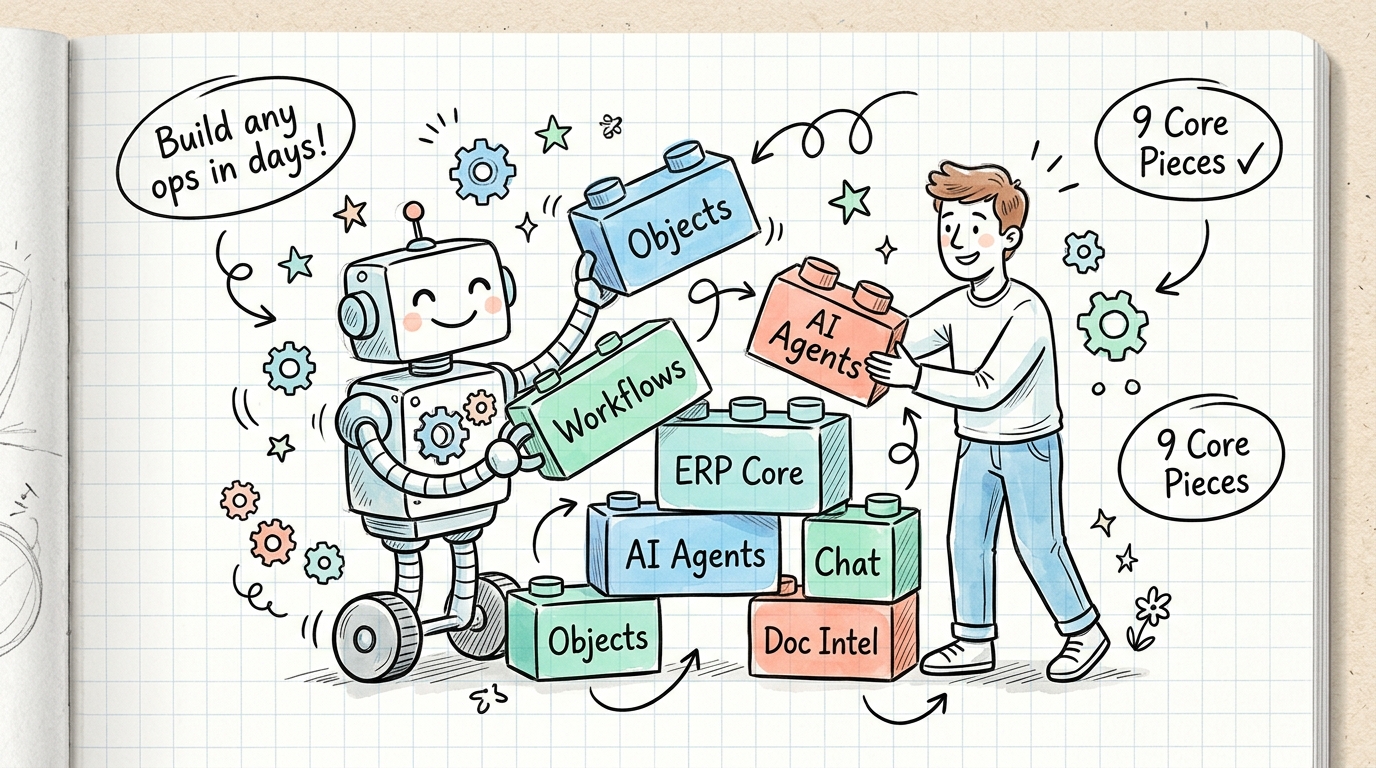
The 9 Universal LEGO Blocks of DualforceOS
Every complex operational flow can be decomposed into nine fundamental primitives that interconnect effortlessly:
- 1. Universal Objects: Structured schemas for customers, quotes, orders, and products.
- 2. Autonomous Agents: Specialized digital teammates equipped with scoped tool calling.
- 3. Conversational Threads: Permanent chat rooms bonded directly to work objects.
- 4. Double-Entry Ledger: Immutable debits and credits recording all financial transactions.
- 5. Universal Kanban & Tasks: Visual pipeline boards linking deliverables to customer accounts.
- 6. Document Intelligence: Vision AI that parses unstructured PDFs into typed database rows.
- 7. Organization Governance: Role-based permissions, agent reporting lines, and audit trails.
- 8. Attention Queue ("Needs You"): Unified triage inbox for approvals, exceptions, and sign-offs.
- 9. Zero-Code Extension: Visual schema customization without developer backlogs.
How Composability Enables Agile Growth
Because these nine blocks share a common relational foundation, teams assemble new business processes in hours instead of quarters. If you launch a new subscription revenue stream, you simply connect the Universal Object to the Double-Entry Ledger and assign @SalesBot to handle renewals.
Future-Proofing Your Enterprise Against Tech Debt
Monolithic ERP architectures age like milk; composable architectures age like wine. As AI models and business requirements evolve, you swap or enhance individual blocks without touching the underlying relational kernel.